
2026 ADVENT: BIBLE PROJECT SERIES

What Is Advent?
The Advent season is a four-week period in the Christian calendar that prepares people for Jesus Christ’s birth at Christmas, while also pointing ahead to his promised return. Each Sunday of the season traditionally spotlights a key theme—like hope, peace, joy, or love—to invite reflection, prayer, and expectant celebration.
The Meaning and Significance of Advent
For many, “advent” means a countdown to Christmas. Whether we envision candy-filled Advent calendars or lights draped over houses with nativity scenes out front, Advent marks a happy season of celebrating.
But the word “advent” comes from the Latin adventus, which is about a “coming” or an “arrival.” The Latin translation of the New Testament uses adventus to describe God the Son arriving on Earth, born as Jesus of Nazareth during the 1st century C.E. (see Acts 7:52). Still, throughout Church history, Advent has more traditionally referred to Jesus’ future arrival, when he comes to complete his work of restoring all creation (see Matt. 24:27; 1 Cor. 15:23; 1 Thess. 3:13).
The Advent season leads to the celebration of Jesus’ birth and also emphasizes his future arrival. It’s a season that includes practices like prayer, giving to those in need, and worship (plus more, depending on the tradition). And it reminds us that we’re living during the time between Jesus’ first and second advents, leading us to lament the hardships we experience in a still-broken world, while also forming us into people who wait with longing for the renewed world to come.
Celebrating Advent also means living into it by practicing a generous way of love and care for our neighbors as we partner with Jesus to bring peace on Earth.
The Four Weeks of Advent
In most Christian traditions, Advent is a four-week season of celebration and observation prior to Christmas, each week often focusing on a particular biblical theme. Although the selection and arrangement of themes can vary, these are some themes commonly explored during Advent.
Week 1: Hope
Week 2: Peace
Week 3: Joy
Week 4: Love
This guide is intended to help you meditate on each of these themes so that you might deepen your understanding of Advent and experience the season in a new way.
Week 1: HOPE

HOPE
Sometimes hope feels wishful, like crossing our fingers and dreaming of a better outcome. We might hope for better employment, healed relationships, or a brighter future. But that kind of hope is based on things that may or may not happen. When things don’t go as we hoped, it can be crushing—our hope disappearing like vapor.
As a season of reflection and contemplation, Advent invites us to imagine a different kind of hope, rooted in the unchanging nature of God and his promise to restore every part of his creation. Advent hope does not minimize pain or difficulty, nor does it assume things will soon get better. Instead, it faces the darkness with courage and chooses to trust that God’s promises will come to pass, guaranteed by his long-proven, faithful character.
In the Hebrew Bible, the words most often used for hope—qavah and yakhal—are also translated as “wait.” To hope in God means to wait with patient expectation, trusting that he will fulfill his promises. This kind of waiting leans forward, anticipating the day when Jesus will return to make all things new. Such hope empowers people to persevere, to act justly, and to serve others as a sign of the restoration that will arrive through Jesus.
YAKHAL / HOPE
READ: PSALM 130:1-8 NASB
Hope in the Lord’s Forgiving Love.
A Song of Ascents.
Out of the depths I have cried to You, Lord.
Lord, hear my voice!
Let Your ears be attentive
to the sound of my pleadings.
If You, Lord, were to keep account of guilty deeds,
Lord, who could stand?
But there is forgiveness with You,
So that You may be revered.
I wait for the Lord, my soul waits,
and I wait for His word.
My soul waits in hope for the Lord
More than the watchmen for the morning;
yes, more than the watchmen for the morning.
Israel, wait for the Lord;
For with the Lord there is mercy,
and with Him is abundant redemption.
And He will redeem Israel
from all his guilty deeds.
CONSIDER
When the psalmist cries out from “the depths” in Psalm 130:1, he reminds us that hope often rises from places of despair. Sometimes people suffer from the bad choices of others. But here, the poet asks for forgiveness, implying that the suffering he’s experiencing is the result of his own people’s (and perhaps his personal) bad decisions (see Ps. 130:4, 8). Rather than despairing, the psalmist remains confident in God’s merciful character, trusting God to forgive and exhibit loyal love.
The psalmist compares his hopeful waiting to watchmen stationed on the city walls during a long night, staying attentive to any sign of enemies. The watchmen eagerly anticipate the dawn, certain that night’s darkness cannot last forever. And the psalmist’s trust in God surpasses even the certainty that the sun will rise.
The watchmen base their confident expectation on history—the sun rises every morning. The psalmist similarly trusts in God based on history—the way God has always operated. God rescued and redeemed his people from brutal slavery in Egypt, crushing an oppressive empire thought to be unstoppable. And when Israel later rejected God by ignoring his instruction, God responded with forgiveness, revealing himself to be “compassionate and gracious, slow to anger, overflowing with loyal love and faithfulness” (Exod. 34:6b, BibleProject Translation).
Rooted in this knowledge, the psalmist trusts that God is willing and able to redeem his people from their failures and the resulting consequences (Ps. 130:7). And he invites all Israel to join him in patient, hopeful waiting.
Israel’s story suggests that human effort alone cannot fix the damage people have unleashed in God’s good world. We all need someone who can truly embody God’s wisdom and lead us back to life. Advent hope acknowledges human failure and need for God without shaming. Followers of Jesus embrace a way of patience with themselves and one another, a way of mercy and forgiveness, waiting upon the one who brings new light every morning and redeems us from every form of brokenness.
REFLECT:
God describes himself as “compassionate and gracious, slow to anger, overflowing with loyal love and faithfulness, maintaining loyal love for thousands, forgiving iniquity, transgression, and sin” (Ex. 34:6b-7a, BibleProject Translation). How might this understanding of God strengthen hope when you’re suffering or feeling despair?
Week 2: PEACE

PEACE
We often hear that peace comes through strength. If our military is the most powerful fighting force, our enemies won’t challenge us and we’ll have peace. Taking the opposite approach, some try to “keep the peace” by avoiding conflict and ignoring problems, hoping they’ll solve themselves. Like Israel’s false prophets, they provide superficial harmony, saying, “Peace, peace!” But in reality, nobody is truly at peace (Jer. 6:14).
The kind of peace envisioned during Advent comes not through military victory or avoidance of reality but through the way of Jesus. He brings true peace by honestly addressing and working to heal the deeper sources of division, such as fear and pride, that compel people to violence. Jesus reconciles all things to himself, offering healing and restoration through love and forgiveness.
As Jesus continues his work of bringing real, lasting peace throughout the Earth, we can participate in that work by living as peacemakers. We join with Jesus by embracing his non-violent way of forgiveness, caring for our neighbors, and extending generous love toward all people.
SHALOM / PEACE
READ: Isaiah 9:1-7 NASB
The Prince of Peace Who Ends Violence
1But there will be no more gloom for her who was in anguish. In earlier times He
treated the land of Zebulun and the land of Naphtali with contempt, but later on
He will make it glorious, by the way of the sea, on the other side of the Jordan,
Galilee of the Gentiles.
2The people who walk in darkness
will see a great light;Those who live in a dark land,
the light will shine on them.
3You will multiply the nation,
you will increase their joy;
they will rejoice in Your presence
as with the joy of harvest,
as people rejoice when they divide the spoils.
4For You will break the yoke of their burden and the staff on their shoulders,
the rod of their oppressor, as at the battle of Midian.
5For every boot of the marching warrior in the roar of battle,
and cloak rolled in blood, will be for burning, fuel for the fire.
6For a Child will be born to us, a Son will be given to us;
and the government will rest on His shoulders;
and His name will be called Wonderful Counselor, Mighty God,
Eternal Father, Prince of Peace.
7There will be no end to the increase of His government or of peace
on the throne of David and over his kingdom,
to establish it and to uphold it with justice and righteousness
from then on and forevermore.
The zeal of the Lord of armies will accomplish this.
Consider
Isaiah 9 speaks into a time of fear, instability, and political failure. When the Judean King Ahaz, a descendant of David, is threatened by enemy armies, he chooses to rely on Assyria, rather than trusting in God’s protection (see Isa. 7:1-17; 2 Kgs. 16:1-9). Ahaz seeks peace by relying on the power of an empire—a power that will ultimately be turned against him. Eventually, the Assyrian army marches not only against Judah’s enemies but also into Judah itself (see Isa. 8:6-8).
In the face of Ahaz’s failure, God promises to raise up a different kind of king, who will rule on David’s throne in righteousness and justice forever. As a “Prince of Peace” (Isa. 9:6), this king will secure peace not through military strength but through ending violence altogether. Isaiah’s image of breaking the “rod of their oppressor” represents destroying all instruments of war, brutality, and tyranny (Isa. 9:4). And the destruction of “every boot of the marching warrior in the roar of battle, and cloak rolled in blood” symbolizes removing all traces of war (Isa. 9:5).
When this coming ruler halts the cycle of violence, people will respond by reshaping their weapons into agricultural tools, transforming objects used for killing into objects used for cultivating and nourishing life (see Isa. 2:4). So competition over resources will give way to kindness and generous sharing of every necessity.
Following this Prince of Peace means refusing to return violence for violence. It means becoming people who embody his reconciling presence in the world. Whenever we overturn injustice and bring healing in place of harm, we are pointing toward his Kingdom of peace.
REFLECT
God describes himself as “compassionate and gracious, slow to anger, overflowing with loyal love and faithfulness, maintaining loyal love for thousands, forgiving iniquity, transgression, and sin” (Ex. 34:6b-7a, BibleProject Translation). How might this understanding of God strengthen hope when you’re suffering or feeling despair?
Week 3: JOY
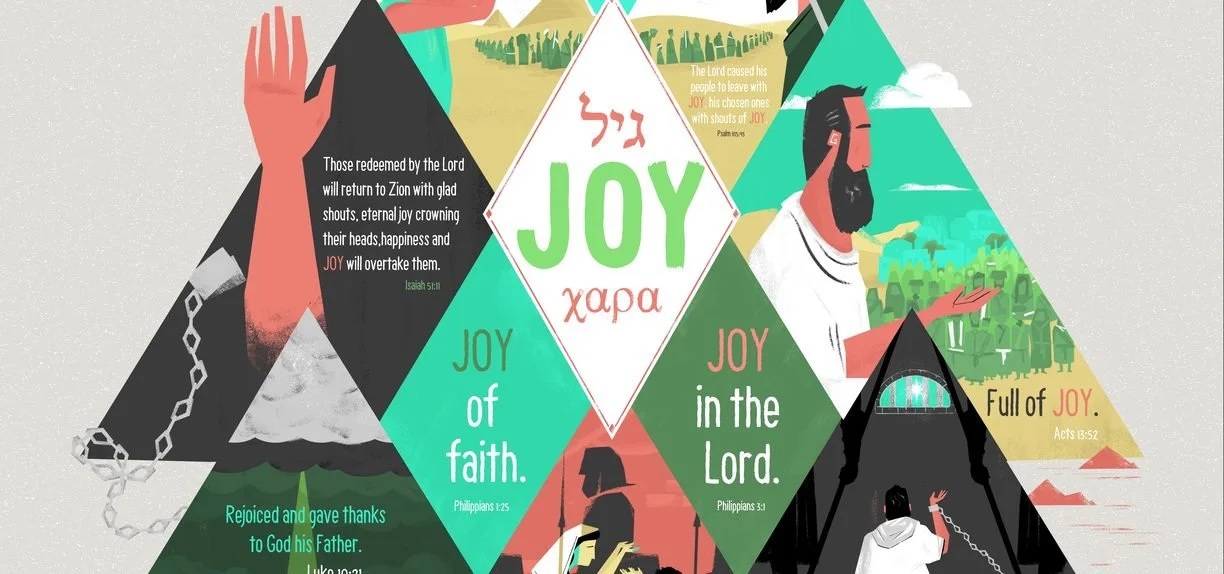
JOY
We often think about joy as an experience of happiness based on favorable circumstances: a stroke of good luck, a personal achievement, or a long-held desire finally being satisfied. But when joy depends on circumstances, it fades fast when the good times end.
Advent joy is not about general happiness stemming from good times. It’s a deep sense of safety and freedom people feel because of God’s loving character, which remains constant through all circumstances, and because God can be trusted to ultimately bless and heal creation as he promised. Similar to the joy a friend’s presence brings on good days and bad, we experience joy as God walks with us through the fluctuations of life’s positive and painful circumstances.
In the Bible, people express joy both when God delivers them from situations of oppression and while still in the middle of exile, persecution, and pain. As people remember God’s loving, rescuing actions throughout history, they wait in joyful hope for him to act in the future, even when that waiting requires patient suffering.
This kind of joy is about being united with the God who walks with us and trusting that he will one day wipe away every tear. It looks to the future but also takes root in our present reality. The season of Advent invites us to experience joy not because everything is perfect but because God is with us and his joy is already breaking into the world.
CHARA / JOY
Joy in Jesus’ Kingdom
Read: Luke 2:8-14 NASB
8In the same region there were some shepherds staying out in the fields and keeping watch over their flock at night. 9And an angel of the Lord suddenly stood near them, and the glory of the Lord shone around them; and they were terribly frightened. 10And so the angel said to them, “Do not be afraid; for behold, I bring you good news of great joy which will be for all the people; 11for today in the city of David there has been born for you a Savior, who is Christ the Lord. 12And this will be a sign for you: you will find a baby wrapped in cloths and lying in a manger.” 13And suddenly there appeared with the angel a multitude of the heavenly army of angels praising God and saying, 14“Glory to God in the highest, and on earth peace among people with whom He is pleased.”
Read: John 15:9-17 NASB
9Just as the Father has loved Me, I also have loved you; remain in My love. 10If you keep My commandments, you will remain in My love; just as I have kept My Father’s commandments and remain in His love. 11These things I have spoken to you so that My joy may be in you, and that your joy may be made full.
12“This is My commandment, that you love one another, just as I have loved you. 13Greater love has no one than this, that a person will lay down his life for his friends. 14You are My friends if you do what I command you. 15No longer do I call you slaves, for the slave does not know what his master is doing; but I have called you friends, because all things that I have heard from My Father I have made known to you. 16You did not choose Me but I chose you, and appointed you that you would go and bear fruit, and that your fruit would remain, so that whatever you ask of the Father in My name He may give to you. 17This I command you, that you love one another.
Consider
On the day of Jesus’ advent, an angel announces to a group of shepherds that God’s promised king is arriving in Bethlehem. This message is “good news of great joy which will be for all the people” (Luke 2:10). For centuries, Israel languished under foreign empires, longing for the arrival of God’s promised king who would bring lasting justice, peace, and healing (see Isa. 9:6-7, 11:1-9). But when the angel joyfully proclaims that this king has finally come, the people are not expecting this kind of arrival—or this kind of king.
Jesus does not overthrow human enemies or establish a dominant throne in Jerusalem. Instead, he challenges the root cause of his people’s suffering by fighting their true enemies—sin and death. These are the powerful forces of corruption that not only fuel Rome’s oppression but also enslave all humanity and compel every form of evil. By defeating these enemies, Jesus invites us into a new way of life in his Kingdom of humility, generosity, and love.
Jesus explains that by living according to his instruction, people receive his own joy, which eventually becomes “full” or “complete” (Greek: pleroo, John 15:11). And the most fundamental way to follow his instruction, he says, is to “love one another, just as I have loved you” (John 15:12).
Jesus is not inviting people to embrace generally warm affections toward others. He wants them to love others as he has loved them. Real joy is rooted in the self-giving love of Jesus.
REFLECT:
Consider the claim that true joy is found in self-giving love and following the way of Jesus. How does this relate to popular assumptions about joy today?
Week 4: LOVE

LOVE
Love is often seen as a force beyond our control, something people fall in or out of. Or it may seem like something satisfying that we can achieve, driving us to chase affection through relationships or status. “Love is all you need,” they say, because it’s the path to self-fulfillment.
But something is missing from that picture of love. The Bible invites us to see a kind of love that’s neither accidental nor driven by desire for self-fulfillment. Instead, it involves a steady commitment to care for the well-being of others—never self-seeking, always self-giving—even when it costs us.
Jesus shows this kind of love when he gives his life for friends and enemies alike. Dying on a cross, with his killers still laughing at him, Jesus cares for their well-being as he prays for their forgiveness (Luke 23:34). Living with this kind of love does not mean ignoring our own needs or devaluing ourselves. After all, Jesus says to “love your neighbor as yourself” (Matt. 22:39). But it means choosing to see all people as living miracles of God, each made in God’s image and deeply loved by him.
The Advent season leads us to reflect on the future God is bringing, where every interaction will be shaped and compelled by love. Even more, it invites us to live into that coming world right now by loving others the way Jesus does. As we give of ourselves in order to care for both friends and enemies, we demonstrate the love that Jesus shows to all people.
AGAPE / LOVE
All the Laws Lead to Love
Read: Deuteronomy 6:5 NASB
5And you shall love the Lord your God with all your heart and with all your soul and with all your strength.
Read: Leviticus 19:18 NASB
18You shall not take vengeance, nor hold any grudge against the sons of your people, but you shall love your neighbor as yourself; I am the Lord.
Read: Mark 12:28-31 NASB
28One of the scribes came up and heard them arguing, and recognizing that He had answered them well, asked Him, “What commandment is the foremost of all?” 29Jesus answered, “The foremost is, ‘Hear, Israel! The Lord is our God, the Lord is one; 30and you shall love the Lord your God with all your heart, and with all your soul, and with all your mind, and with all your strength.’ 31The second is this: ‘You shall love your neighbor as yourself.’ There is no other commandment greater than these.”
Read: Luke 6:27-36 NASB
27“But I say to you who hear, love your enemies, do good to those who hate you, 28bless those who curse you, pray for those who are abusive to you. 29Whoever hits you on the cheek, offer him the other also; and whoever takes away your cloak, do not withhold your tunic from him either. 30Give to everyone who asks of you, and whoever takes away what is yours, do not demand it back. 31Treat people the same way you want them to treat you. 32If you love those who love you, what credit is that to you? For even sinners love those who love them. 33And if you do good to those who do good to you, what credit is that to you? For even sinners do the same. 34And if you lend to those from whom you expect to receive, what credit is that to you? Even sinners lend to sinners in order to receive back the same amount. 35But love your enemies and do good, and lend, expecting nothing in return; and your reward will be great, and you will be sons of the Most High; for He Himself is kind to ungrateful and evil people. 36Be merciful, just as your Father is merciful.
Consider
On the day of Jesus’ advent, an angel announces to a group of shepherds that God’s promised king is arriving in Bethlehem. This message is “good news of great joy which will be for all the people” (Luke 2:10). For centuries, Israel languished under foreign empires, longing for the arrival of God’s promised king who would bring lasting justice, peace, and healing (see Isa. 9:6-7, 11:1-9). But when the angel joyfully proclaims that this king has finally come, the people are not expecting this kind of arrival—or this kind of king.
Jesus does not overthrow human enemies or establish a dominant throne in Jerusalem. Instead, he challenges the root cause of his people’s suffering by fighting their true enemies—sin and death. These are the powerful forces of corruption that not only fuel Rome’s oppression but also enslave all humanity and compel every form of evil. By defeating these enemies, Jesus invites us into a new way of life in his Kingdom of humility, generosity, and love.
Jesus explains that by living according to his instruction, people receive his own joy, which eventually becomes “full” or “complete” (Greek: pleroo, John 15:11). And the most fundamental way to follow his instruction, he says, is to “love one another, just as I have loved you” (John 15:12).
Jesus is not inviting people to embrace generally warm affections toward others. He wants them to love others as he has loved them. Real joy is rooted in the self-giving love of Jesus.
REFLECT:
Consider the claim that true joy is found in self-giving love and following the way of Jesus. How does this relate to popular assumptions about joy today?